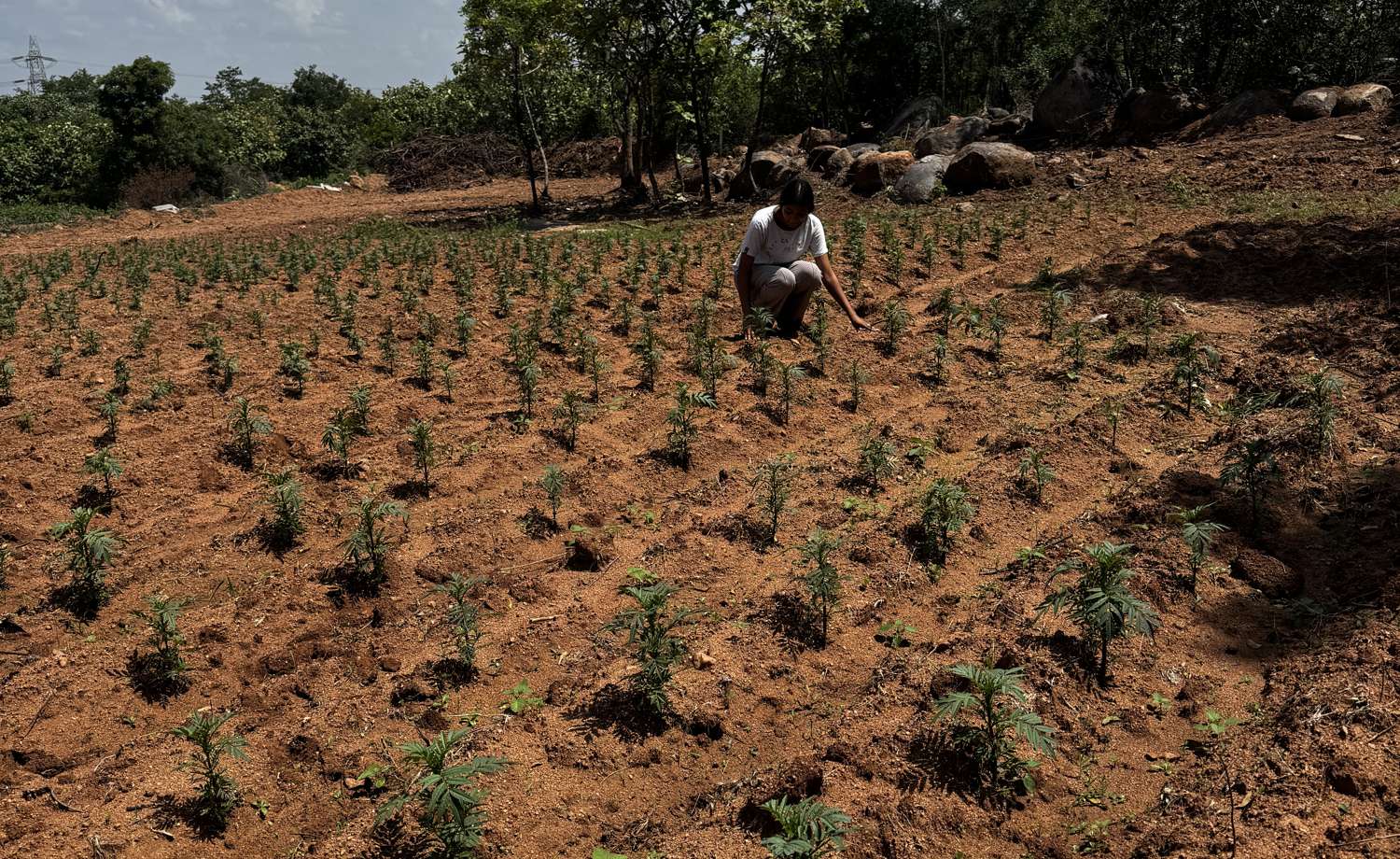
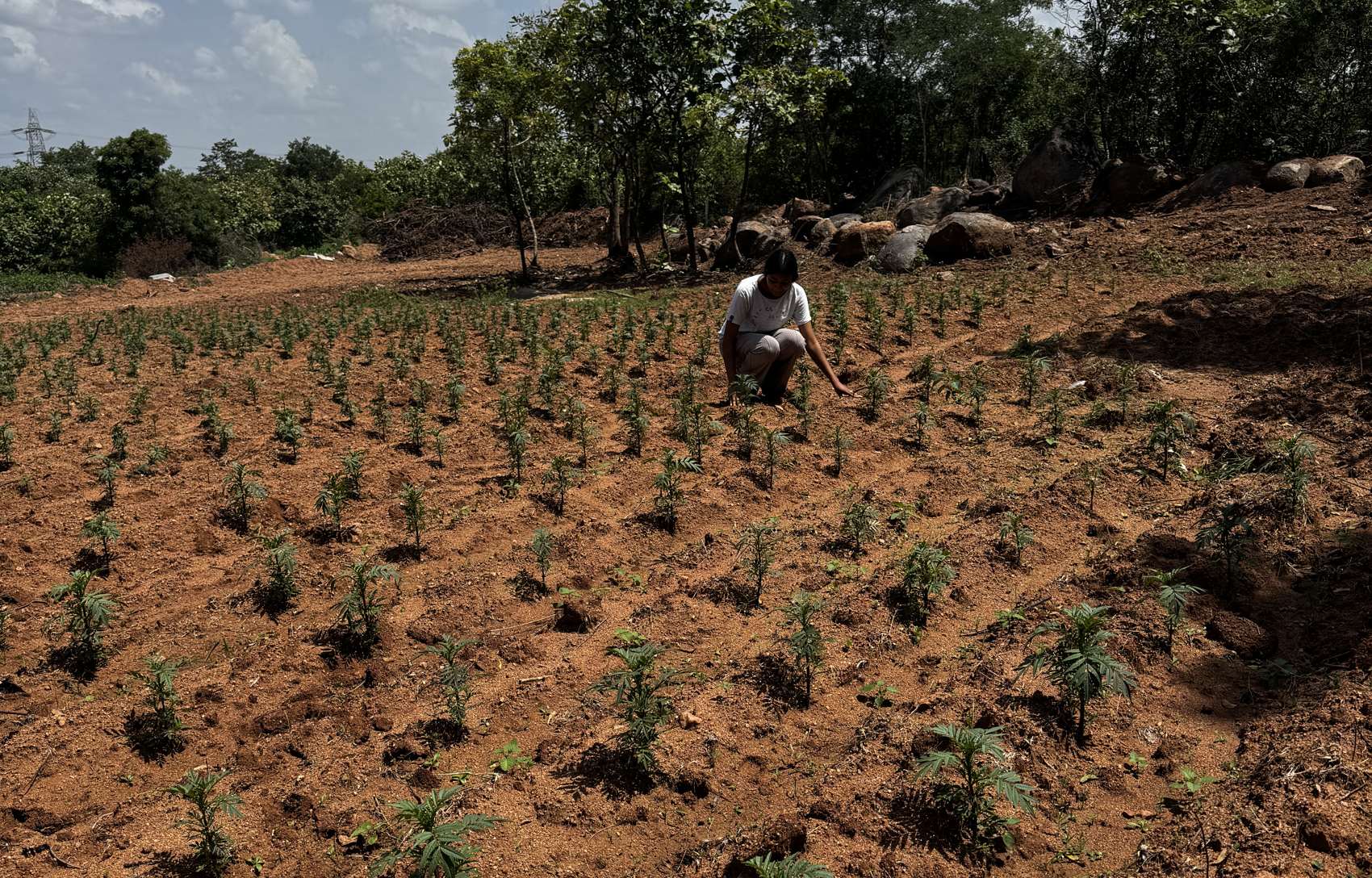

Kruthika Mopperthy crouching among rows of young marigold plants in a red-soil field
The Farming Girl · Murali Nagar

Student by week.
Farmer by weekend.

Every Saturday and Sunday, Kruthika Mopperthy trades her textbooks for the soil — growing rice, vegetables and fruit the way nature intended. No chemicals. No shortcuts. Just patience.

35
Days to bloom

The marigold rows are counting down.

Planted · knee-high greenDay 35 · orange and gold
Close view of hands settling a marigold seedling into red soil, a planted row running away from the camera
Day zero · the row set out by hand

Each seedling is set by hand, firmed into the red soil and checked again on the next visit. In the early weeks the field looks quiet — only small green plants in long rows. Then buds begin to appear, and the same rows slowly turn into a band of orange and gold. The countdown is not only to flowering; it is a lesson in waiting for nature's timing.

The marigolds also make the farm feel alive. They bring colour between food crops, attract insect activity around the field, and remind us that farming is not only about yield. A healthy farm can also be beautiful.

Her story

It began with a school project.

What started as a Class 10 study on processed food became a question Kruthika could not leave in the classroom: if food affects our health, shouldn't we also understand the soil, water, seed and care that create that food? That question took her to the farm — and kept bringing her back every weekend.

Mon — Fri · The student

Classes, homework, questions

The Class 10 project on processed food and what it does to our health started it all. Two years on, in Class 12, the questions have not stopped.

Sat — Sun · The farmer

At the farm by sunrise

Tending paddy, planting marigolds, feeding calves, learning directly from the land — one weekend at a time, in Murali Nagar.
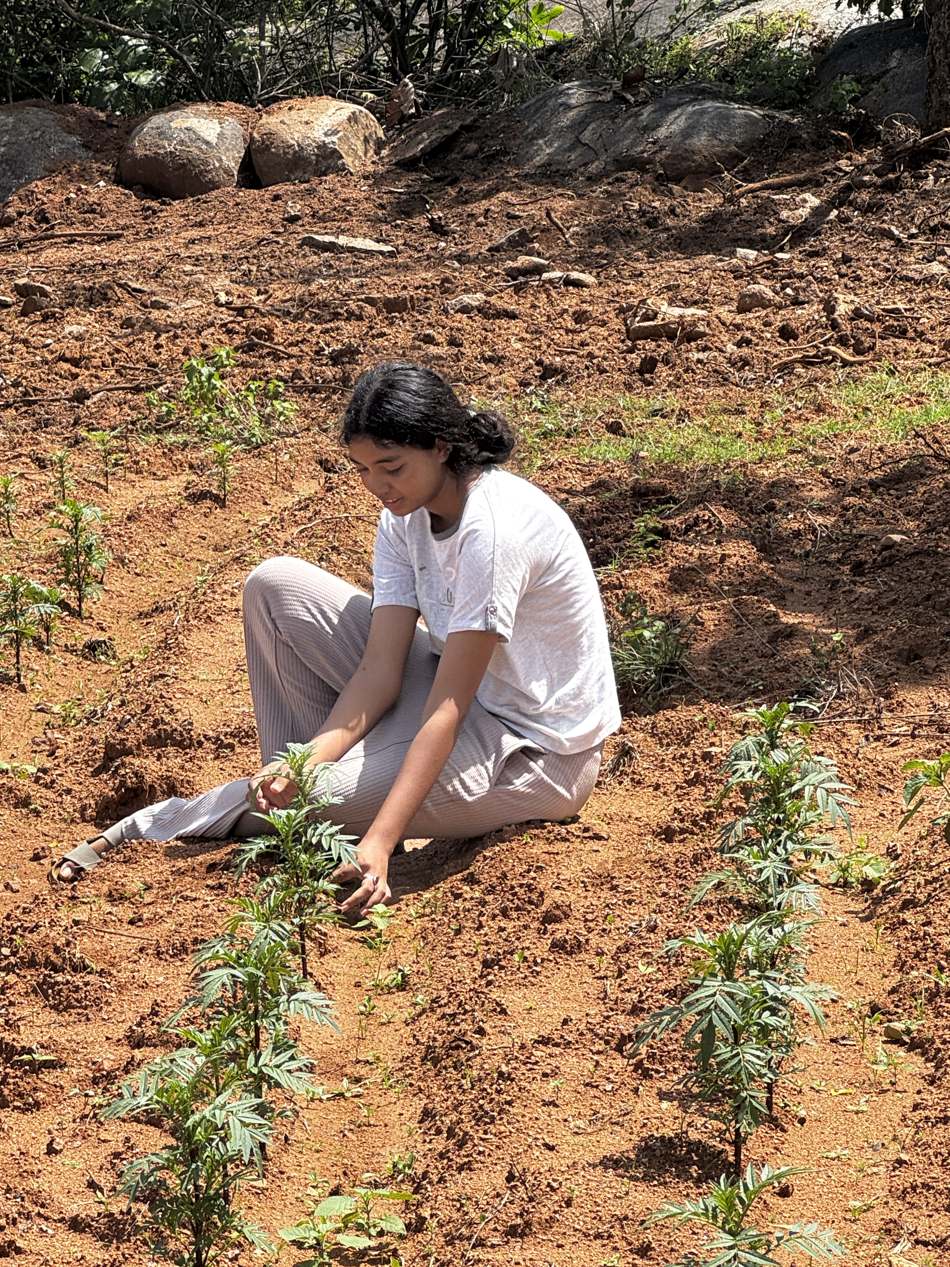
Kruthika sitting on the red soil, planting a young marigold by hand
A weekend morning · working the soil by hand

Weekends taught her patience, responsibility, and a deep affection for the calves, cows and goats she cares for. Rather than seeing agriculture as an outdated profession, she believes it is an essential part of India's future — and that Gen Z belongs in it.

At first, the farm was simply a place to observe. Then observation became participation. She began learning how paddy is tended, how vegetables respond to water and weather, how a young plant must be handled gently, and how much patience sits behind something as ordinary as a plate of food.

Over the next two-and-a-half years, Saturday and Sunday developed a different rhythm. School books gave way to field rows, seedlings, irrigation lines and conversations with people who have worked the land for decades. She learned to notice small things: the feel of moist soil, the colour of a leaf, the weight of a ready gourd, the sound of animals waiting to be fed.

The experience also changed the way she looks at farming. To her, agriculture is not a story from the past. It is a living system that connects health, climate, water, livelihoods, food quality and the future of young India. The farm became a place where science, responsibility and compassion meet.

She is still a student, still learning, and does not pretend to know everything. That is the point of The Farming Girl: to document the learning honestly — one crop, one mistake, one harvest and one weekend at a time.

The more time I spend on the farm, the more I understand that food begins long before it reaches a kitchen.
Kruthika Mopperthy
2.5+ yrs
of weekend natural farming
Zero
chemical fertilisers or pesticides
5 crops
rice, gourds, greens, fruit & marigolds
The vine rows

Bamboo, twine, and gourds overhead.

Behind the marigold field, the vine rows climb upward. Ridge gourd, bottle gourd and cucumber are guided over a simple trellis so the fruit can hang freely, the leaves can breathe and every plant can be inspected by hand.

The vine rows are where farming becomes very visual. New tendrils appear almost overnight. A flower becomes a tiny fruit, and a tiny fruit can be ready before the next weekend. That speed makes regular observation important.

Kruthika checks the underside of leaves, follows the drip line, looks for damaged growth and learns when to leave a fruit for another day. The rule is simple: harvest because the plant is ready, not because the calendar says it is time.

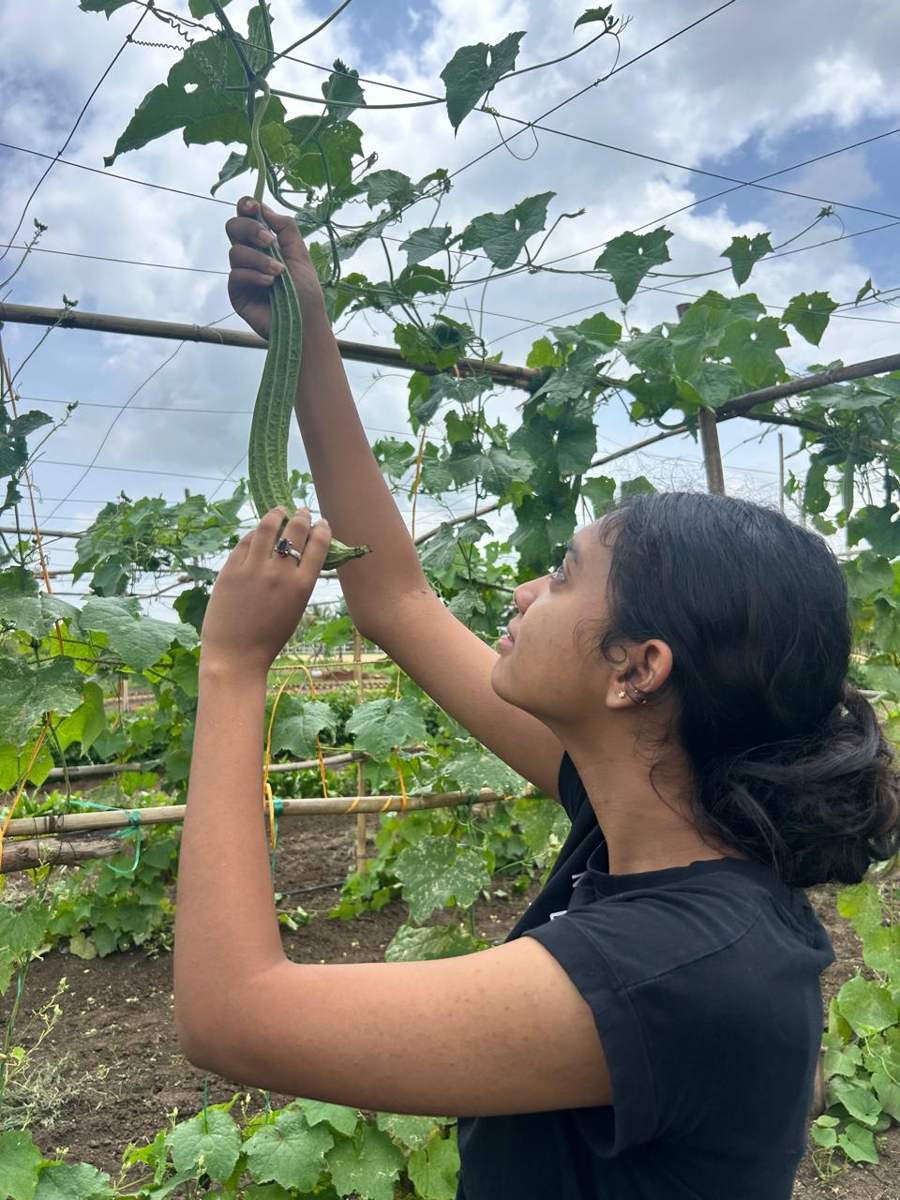
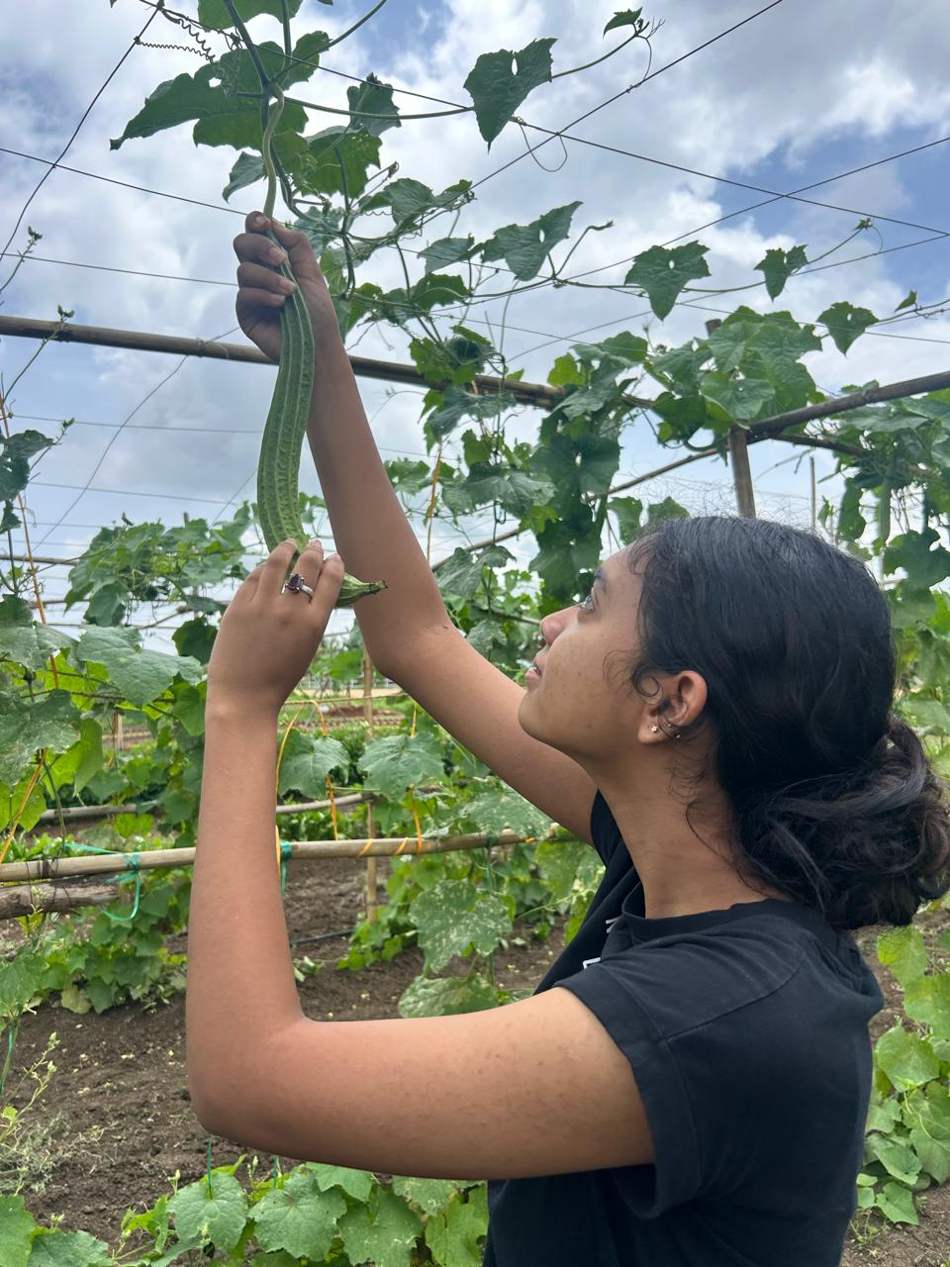
Kruthika reaching up to inspect a long ridge gourd hanging from a bamboo and wire trellis
Ridge gourd · checked before it is cut

Harvest is a judgement call

A ridge gourd left one day too long turns fibrous, and a day too early it has no weight. So she walks the rows, takes each one in her hand and decides. Nothing is picked to fill an order — it is picked when it is ready.

Trained onBamboo & wire
Plastic usedNone
PickedBy hand, weekly
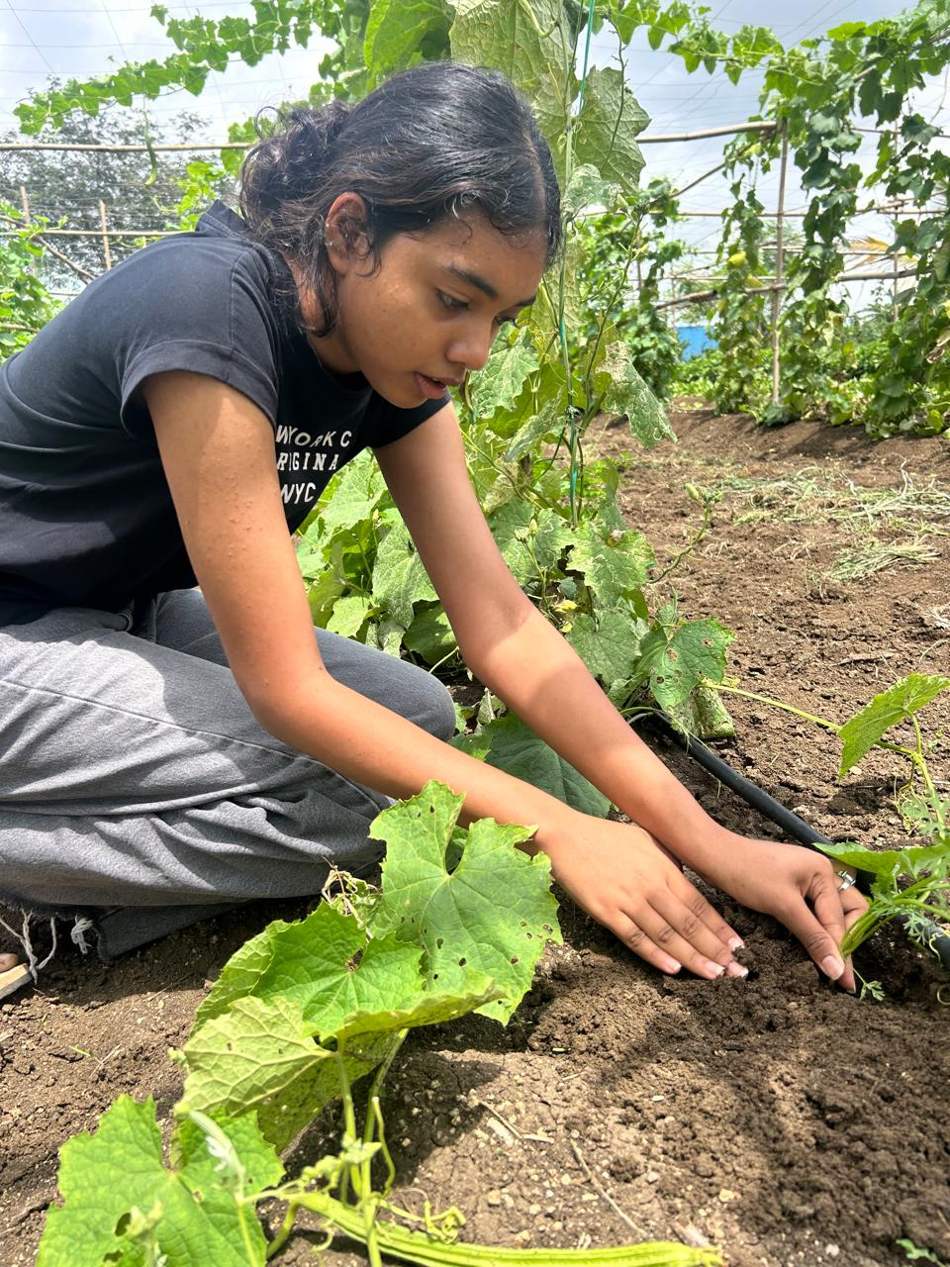
Kruthika kneeling in the soil, laying a black drip irrigation line along the base of the vines
Drip line · water at the root, not on the leaf
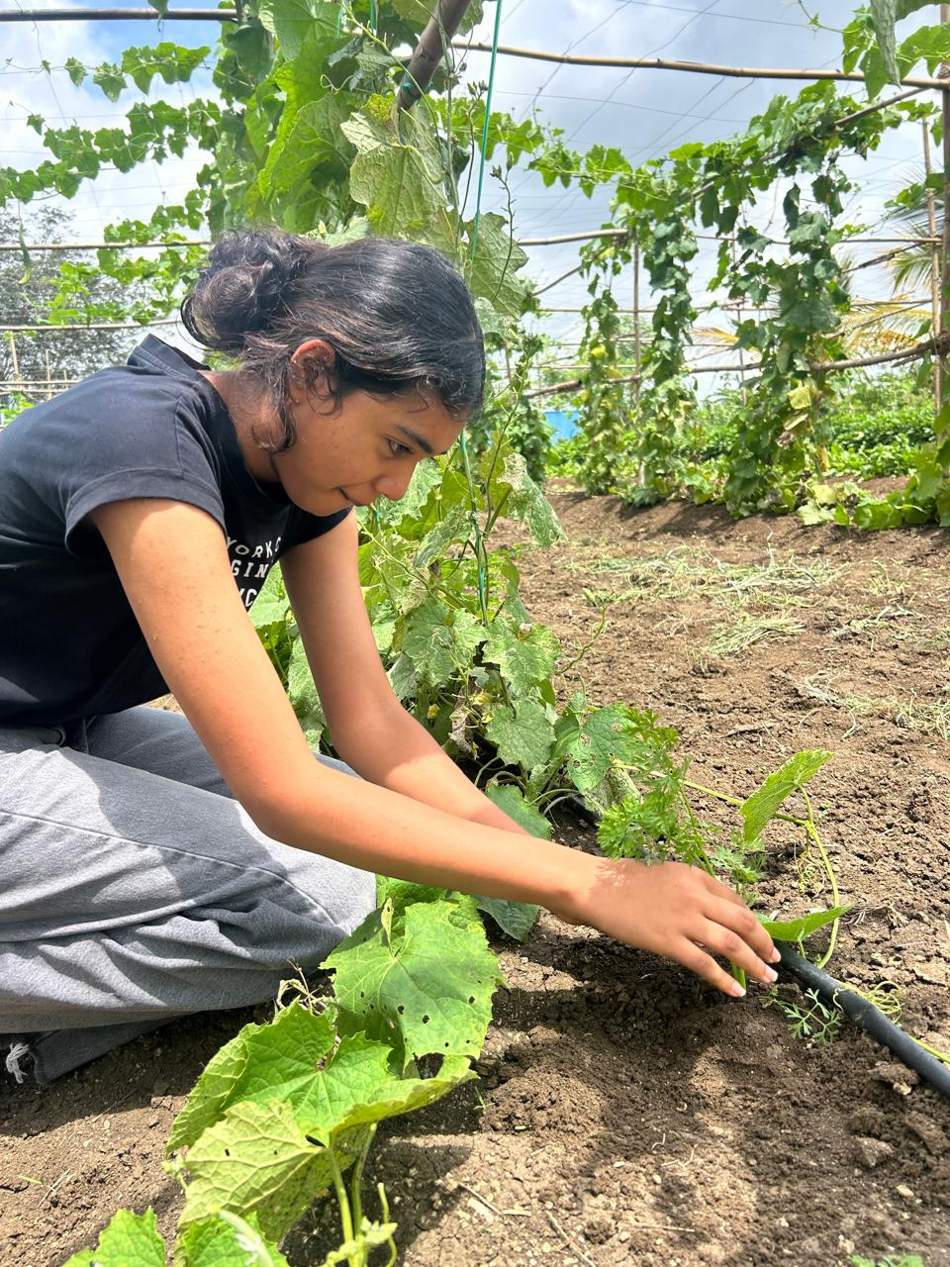
Kruthika settling the drip pipe under the vine canopy
Under the canopy · sorting the pipe by hand

The black pipe running along the base of the vines is doing quiet work. Watering at the root rather than over the leaves keeps the canopy dry, which is how mildew is kept off a gourd crop without a single spray. Mulch does the rest — the soil under those leaves stays damp long after the surface has dried.

Farm diary

Thirty seconds on the farm.

Walking the vine rows with our farm hand, checking how the gourds have come along this week.

Every SatVine row inspection
BambooTrellises, no plastic
ZeroChemical inputs
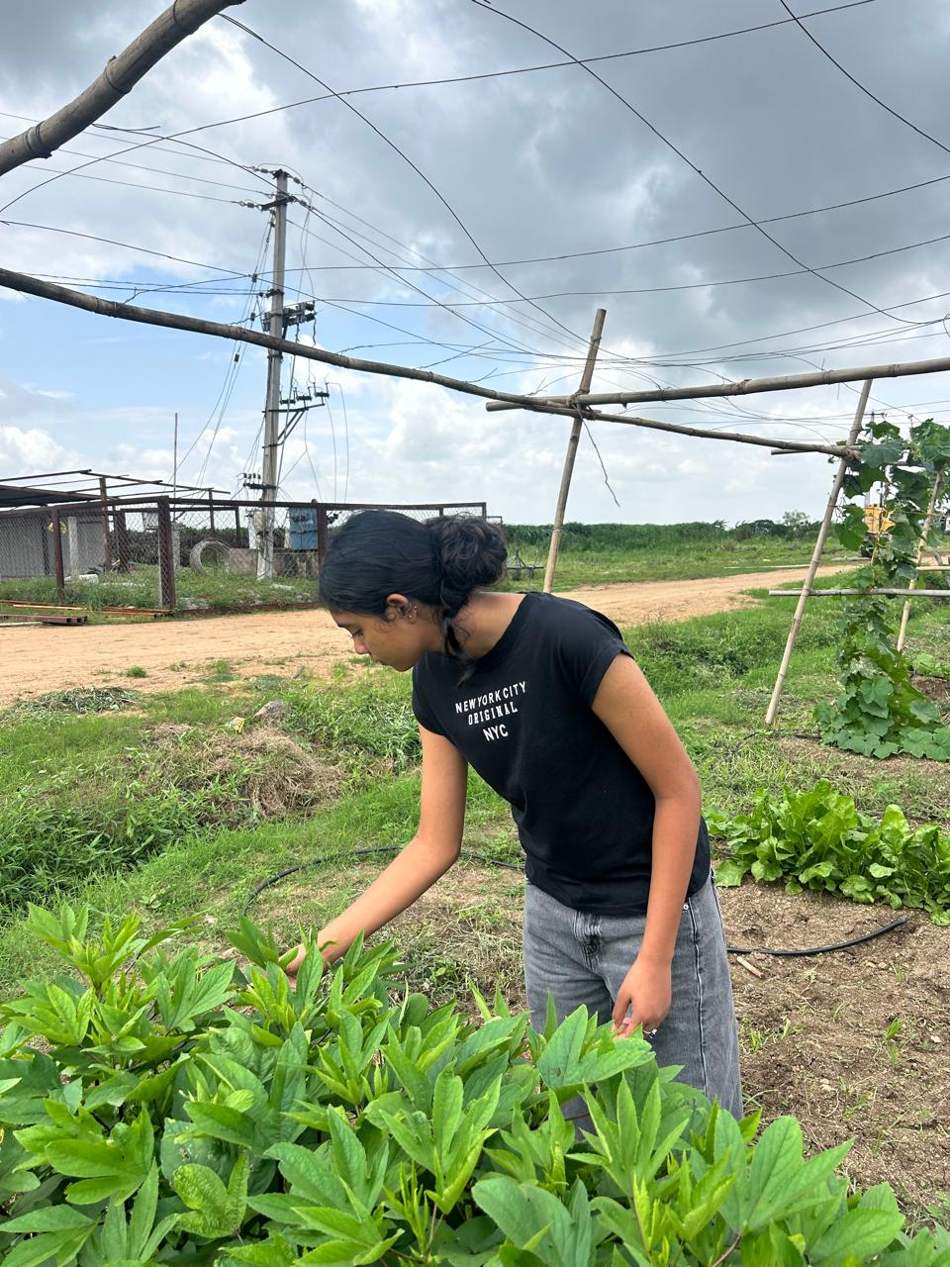
Kruthika bending over a bed of leafy greens, with the farm track and vine frames behind her
Greens bed · picked leaf by leaf, evening rounds

The greens beds, on the way out

The last round of the evening is the greens. Amaranth, spinach and methi grow in short beds by the track — the crop that goes from soil to kitchen in the same day. She picks leaf by leaf rather than pulling the plant, so the same bed keeps giving for weeks.

Learning happens here more than anywhere else: walking the rows, turning leaves over to look for pests, and asking questions of the people who have farmed this land for decades.

In the field

Weekends, as they actually look.

No staged farm shoot — just the real rhythm between Saturday sunrise and Sunday evening: walking the rows, getting hands into the soil, checking water, planting, observing and learning.

Some weekends are about visible progress: a new row planted, vines reaching the trellis, flowers opening. Other weekends are quieter — repairing a line, pulling a weed by hand, checking moisture, feeding animals or simply waiting.

The photographs are a record of that process. They show that farming is repetitive, physical and patient work. The beauty comes from seeing a field change because small tasks were done consistently.

Rows of young marigold plants across a red-soil field, Kruthika working among them
The marigold field · roughly 35 days from full bloom
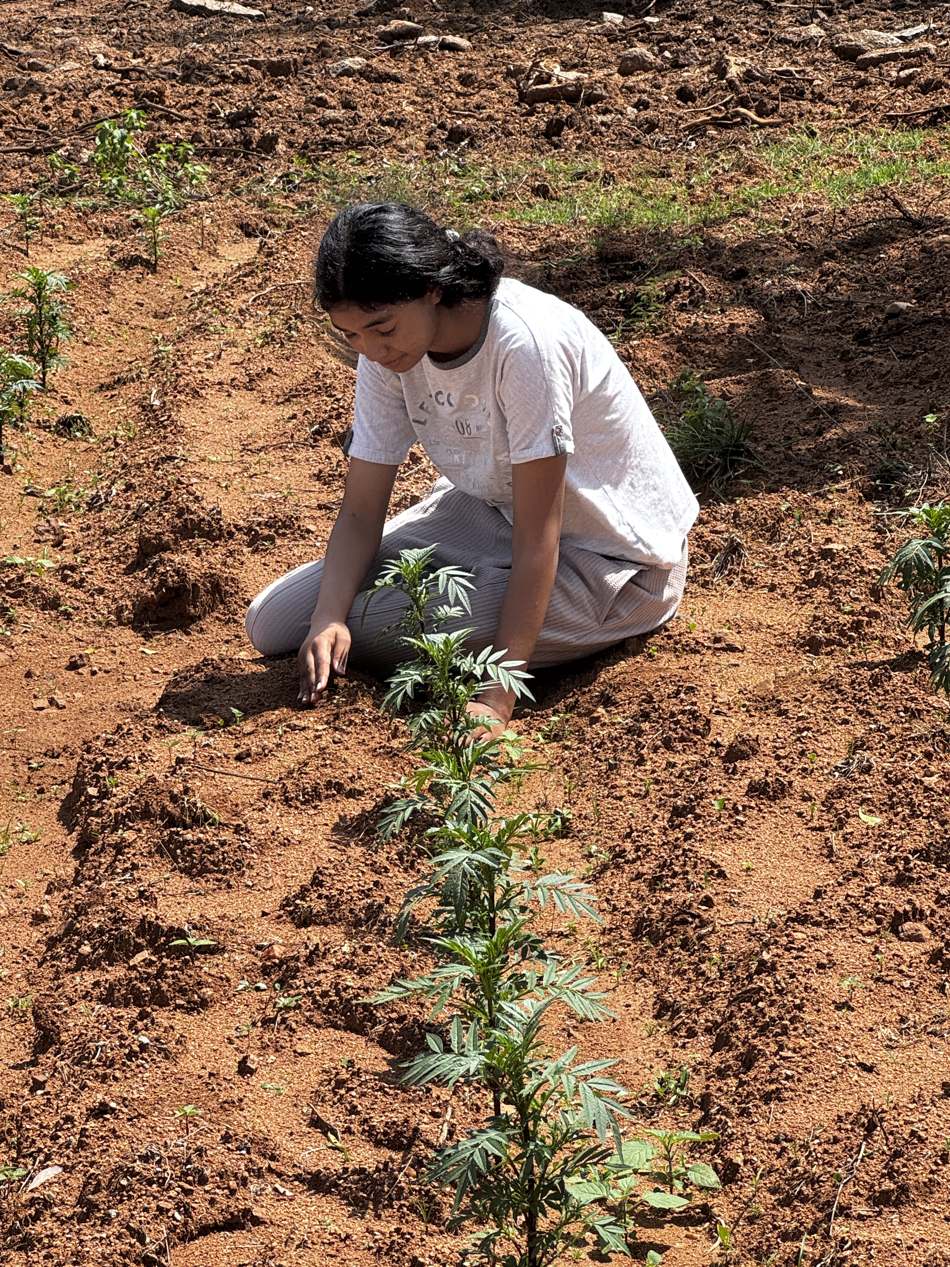
Kruthika sitting on the soil, settling a young marigold plant with both hands
Hands in the soil · planting by hand
Kruthika kneeling beside a marigold seedling, firming the earth around its base
Firming the earth · one plant at a time
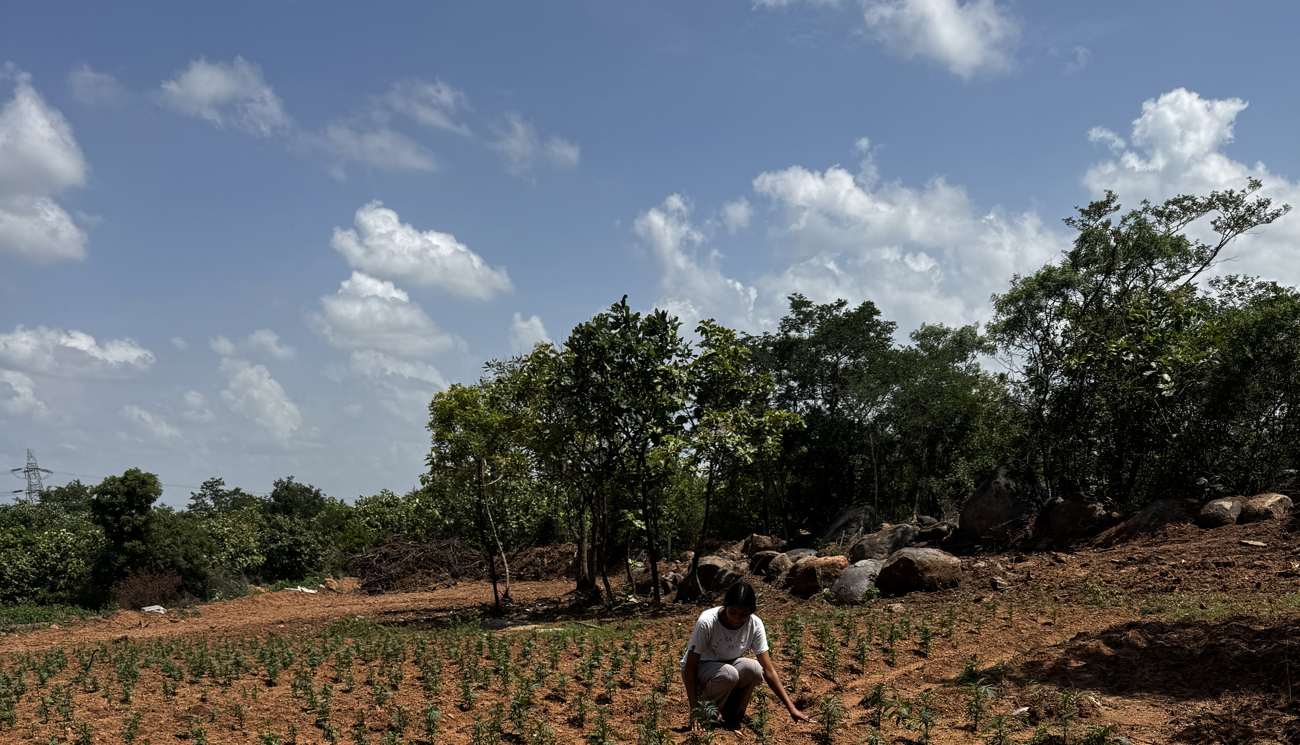
Wide view of the farm: monsoon sky, tree line and boulders above the marigold field
The farm edge · trees, boulders, monsoon sky
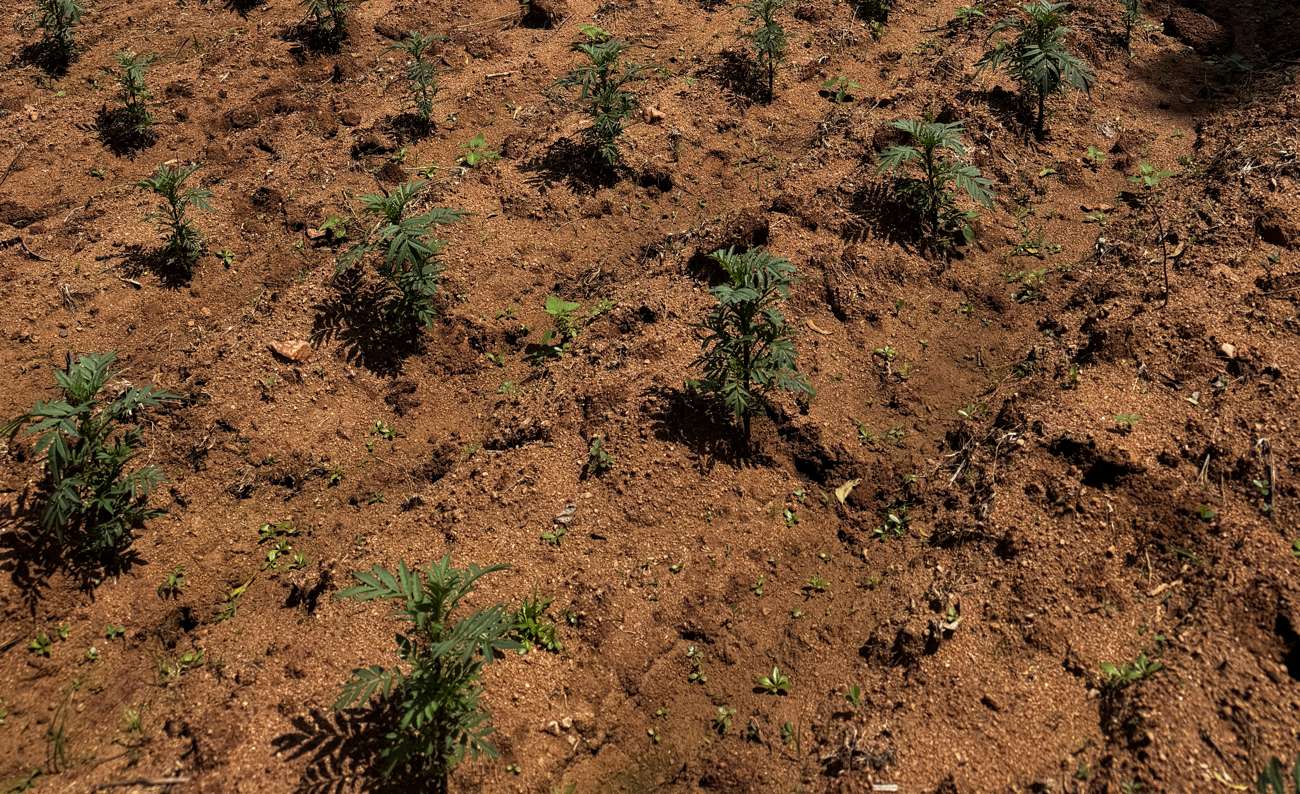
Close rows of young marigold plants in red laterite soil
Row upon row · hand-set over several weekends
Vine canopy on bamboo and wire against a monsoon sky
The vine canopy · gourds hanging clear of the soil
Kruthika seated on the soil among the marigold rows
Morning rounds · checking every row
How we farm

Natural farming, the honest way.

Our approach is simple: build living soil, use water carefully, avoid routine synthetic chemicals, grow diversity, observe before acting and treat every animal with care. The farm is a place for learning, not shortcuts.

🐄

Desi cow at the centre

Jeevamrutham and ghana jeevamrutham made from cow dung and urine feed the soil's microbial life — no synthetic fertiliser ever touches the field.

What this means here
Cow-based natural inputs are prepared and applied as part of the soil-care routine, with the aim of supporting biological activity rather than feeding the crop only through synthetic fertiliser.
🌿

Mulching & ground cover

Crop residue blankets the soil, holding moisture, feeding earthworms and keeping weeds down without herbicides.

What this means here
Dry leaves, crop residue and other available organic matter are kept over exposed soil where practical, helping reduce direct sun on the surface and slowing moisture loss.
🌻

Mixed & companion crops

Rice, vegetables, marigolds and fruit trees grow side by side — diversity above the ground builds resilience below it.

What this means here
Different crops share the farm instead of treating every patch as a single-crop space. Marigolds, greens, gourds, paddy and fruit trees create variety across the field.
🌶️

Natural pest care

Neem-based sprays and agniastram keep pests in check the traditional way, protecting bees and friendly insects.

What this means here
Plants are inspected first. When intervention is needed, the preference is for traditional botanical preparations and farm-made approaches rather than routine chemical spraying.
💧

Water wisdom

Mulch and healthy humus mean the soil drinks less and holds more — every drop is made to count.

What this means here
Drip lines put water close to the root zone, while mulch helps the soil stay moist for longer. Watering is adjusted by looking at the field, not by habit alone.
🤲

Compassion first

Calves, cows and goats are family, not machinery. Care for animals is care for the land.

What this means here
Feeding, cleaning, observing and spending time with the animals are part of the weekend routine. Their wellbeing is treated as part of the health of the whole farm.

Our farm promise

Grow with patience. Harvest only when ready. Keep unnecessary chemicals away from the field. Waste as little as possible. Respect the people, animals, water and soil that make every harvest possible.

Farm naturals

From our weekend soil to your table.

Small-batch produce from the farm, offered according to the season and the actual harvest. Quantities may be limited because we would rather say "not ready yet" than pick something too early.

🌾
Staple

Hand-pounded rice

Naturally grown paddy, hand-pounded to keep the bran and its nutrition intact. 1 kg.

₹160
🫙
Farm-made

A2 cow ghee

Bilona-churned ghee from our own desi cows, grazed and cared for naturally. 250 ml.

₹650
🥬
Weekly box

Seasonal veggie basket

A mixed basket of whatever the farm gives that week — leafy greens, gourds, roots. ~3 kg.

₹340
🥒
Vine row

Ridge gourd & cucumber

Trellis-grown, cut the morning of delivery, never waxed or cold-stored. ~1 kg mixed.

₹90
🌼
In 35 days

Fresh marigold garlands

Hand-picked from the rows in these photos, once the field comes into bloom. Pre-orders open.

₹120

A note before you order: farm availability changes with weather and harvest. Fresh produce is packed as close to harvest as possible. If something is not ready, we will tell you rather than substitute it silently.

Field notes

Learning out loud, one weekend at a time.

Soil · 6 min read

Why my soil smells like rain now

Two years of mulching and jeevamrutham changed everything — here's what happened underground.

Read full note

The first change I noticed was not a number on a report. It was a smell. After rain or watering, the soil began to carry that deep earthy smell I had always associated with healthy ground.

Mulch kept the surface protected, organic inputs were added regularly, and I started finding more small signs of life when I moved the top layer. I am still learning what is happening below the surface, but the lesson is clear: soil is not just something that holds a plant upright. It is a living environment that has to be cared for.

Flowers · 5 min read

Planting 35 days of patience

What it takes to set out a marigold field by hand, and why the waiting is the lesson.

Read full note

Planting marigolds looks simple until you spend hours repeating the same small movement: open the soil, place the seedling, straighten it, firm the earth and move to the next one.

The field does not reward impatience. For weeks there is more green than colour. Then the buds arrive. The 35-day wait taught me something school rarely can: some results cannot be rushed, only prepared for.

Vines · 4 min read

Why we water the root, never the leaf

One length of drip pipe replaced every fungicide we might have needed on the gourds.

Read full note

The vine canopy taught me to think about where water goes, not just how much we use. Keeping water close to the root zone helps us avoid wetting every leaf during routine irrigation.

I learned to follow the pipe, check the soil with my hand and look at the plant before deciding what it needs. The most useful farming tool is often observation.

Gen Z · 5 min read

A school project that never ended

How one Class 10 assignment on processed food turned into a way of life — and why more of us should try it.

Read full note

My Class 10 project began with processed food and health. I thought I was doing an assignment. Instead, it opened a bigger question: what happens before food becomes food?

That question took me to the farm. Farming has shown me biology, weather, patience, labour and responsibility in one place. I want more young people to experience that connection — not because everyone must become a farmer, but because everyone eats.

The farm family

Compassion is a farming practice too.

The animals are not livestock on this farm. They are the reason the soil works.

🐄The cows behind our ghee 🐮Calves, bottle-fed at dawn 🐐The young goats 🐝Pollinators we protect 🪱Earthworms, the real farmers
Sunday harvest note

One short email after each farm weekend.

What's growing, what's ready, and one thing the land taught us.

Your basket

Your basket is empty.
🧺
Total₹0
Added to basket ✿